One of things that we have found ourselves thinking and talking about a lot recently is the relationship people have to meat (flesh). Because of the diverse crowd of consumers at Fleisher's we are exposed many different conceptions and receptions of meat. People want, expect, or believe strange and often contradictory things in terms of the meat products they consume.
Here are just some of the things we have seen:
-People think they want 100% grass-fed meat but they would be outraged at the idea of buying an animal that has been frozen four eight-months. 100% grass-fed animals have a three month period when those animals are ready to slaughter, right after summer, when they have been eating fresh grass all day and gaining wight. The animals eat hay, which has no real nutritional value, all winter and don't put on weight, which means the meat wont be as good. If you want to have grass-fed meat all year long that means the animals must be slaughtered Sept, Oct, and Nov, and be frozen for the year.
-People want to buy high-quality meat- full of flavor, fresh, and tender. But people are freaked out by the fleshiness of meat and cook it till there is no remnants of life, and thus no flavor. Than they are angry that they paid good money for what they think is bad quality meat.
-People want pasture-raised meat, but they expect to see heavy marbling. The kind of marbling we are used to seeing comes from inactive muscles, the result of a penned in animal in factory farming.
-People want to buy sustainably but they expect that every cut of meat should be available to them at all of times. Nose-to-tail butchering is sustainable butchering. It means no parts are wasted, what can't be sold as a cut of meat (for whatever reason) is in to sausage or dog food. It also means that every animal you breakdown that week must sold that week, meat does not ahve a long shelf life. Yet, every animal only has so much of each cut (you must choose between your tenderloins and porterhouses and there is only one skirt per steer).
Showing posts with label local. Show all posts
Showing posts with label local. Show all posts
Wednesday, October 13, 2010

Monday, October 11, 2010
NYTimes Magazine Food Issue(s)
There is a great article, by Christine Muhlke, in this last Sunday's NYTimes Magazine (the annual food issue), titled "Growing Together". The article is all about the way in which food and the current food movement in particular have created different kinds of communities, it is also very honest about the limits of those communities. Everyone should read it, really, it is worth reading the whole issue. Rob Walker describes 'kitchen incubators' in his column 'Consumed'. Michael Pollan, a hero of ours, has a great piece about a 36 hour local food party, we wish we could have been there. Pollan describes the building, the use of, and the symbolic meaning of the communal hearth, an idea that we think and talk about a lot (probably a future SM project). Another short little piece of interest is 'The Cow-munity' about a community of people who buy shares in a pasture raised local steer. It is an example of a good option for those who don't have a Fleisher's nearby, and also of how food can create unusual communities. Also read Pie + Design = Change an article about food, community, art and social intervention!!! It describes a design collective, very much like us, called Project M, we look forward to learning more about them. Finally, is the the west coast that much cooler than us? Certainly the Bay Area seems to be a few steps ahead of us North Easterners: Food Groups.
Sunday, October 10, 2010
Many Meats
The first week of training at Fleisher's Grass-fed and Organic Meats is over. The week really flew by. Fleishers is a unique place for a lot of reasons: the personalities that work there and shop there, the love of food (meat in particular) and the dedication to sustainability. There is a lot to talk about and a lot more time (at least 7 more weeks) to experience and learn new tings.
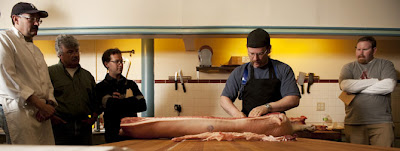
Obviously, when in a butcher shop that has distinguished itself by its dedication to both sustainability and high quality, it brings lots of different kinds of consumers. Customers come to Fleisher's because it is the best butcher-shop in the area, both in quality of meat and also range in product. Some come because of its cult status in the food world. Some come because of its distinctive and marked political position. Some come and buy that rare and luxurious dry aged porterhouse as a celebration, others come on an almost daily basis and buy hamburger meat or chicken wings. Hipsters, bubbies, New Yorkers, Hedge-funders, Woodstockers who never left, and locals all shop here (as well as many of the most trendy restaurants in NYC). All of this is remarkable, the diversity of consumers and there needs are astounding. This diversity is due to Josh and Jess's commitment to high quality product, sustainability, health, and local economy. It is rare to see all this balanced and the success of that balance is what opens itself up to such a wide range of consumers.

Obviously, when in a butcher shop that has distinguished itself by its dedication to both sustainability and high quality, it brings lots of different kinds of consumers. Customers come to Fleisher's because it is the best butcher-shop in the area, both in quality of meat and also range in product. Some come because of its cult status in the food world. Some come because of its distinctive and marked political position. Some come and buy that rare and luxurious dry aged porterhouse as a celebration, others come on an almost daily basis and buy hamburger meat or chicken wings. Hipsters, bubbies, New Yorkers, Hedge-funders, Woodstockers who never left, and locals all shop here (as well as many of the most trendy restaurants in NYC). All of this is remarkable, the diversity of consumers and there needs are astounding. This diversity is due to Josh and Jess's commitment to high quality product, sustainability, health, and local economy. It is rare to see all this balanced and the success of that balance is what opens itself up to such a wide range of consumers.
Thursday, August 26, 2010
Gotland's Crafts
As we talked to Gunilla about our interest in craft traditions and our current Sourced Material: Wool project she got excited. She immediately listed a name of people and places we could go visit and talk to around Gotland. We were excited to see what things we could learn here. Soon Gunilla, along with her sister-in-law Anna had planned a day of crafting and learning for us.


We see this happening in lots of rural areas that see lots of tourism, like Jake Levin's home, the Berkshires. This creates a complicated situation for the people who produce these objects. On the one hand it's wonderful that there is once again an economy for these local products and traditions, but on the other hand it can have an alienating effect- a feeling that one is producing these for an outside market. The touristic-fetishizing of these objects also drives up their prices. On one hand it's good, as it means more income for the local producer, but on the other hand it often means the community can not afford their own local products.

Not surprisingly, the majority of crafts in Gotland have there source in the agriculture here: wool and food (jams, honey, breads). Most of these craft-objects can be bought in the small shops that accompany many of the farms. They can also be found in tourist centers, boutiques in larger towns like Visby, and in small ateliers throughout the island where products- ceramics, candles, textiles, etc- are made and sold.

Our first stop with Gunilla and Anna was in Vallstena, at Ullverkstan Vallstena(Vallstena Wool-workshop), a beautiful wool crafts store and felting studio run by Annika Grandelius. Annika's shop was really exciting, we were immediately inspired. We told her a little bit about Sourced Material: Wool, and she went on to teach us some new techniques in her light-filled and airy studio. Annika has traveled all over Europe and a little in North Africa, learning about different felting techniques and making connections with different felters (she is particularly involved with a group of crafts-people in Estonia). But she is dedicated to using her own wool, from Gotland sheep, and cleaning and dying it herself.

Next we went to southern Gotland, to the town of Hemse. There we visited Gotlands Spinneri where the bulk of Gotland's wool is spun. The Gotland Spinneri has a fascinating history. In 2001 it was announced that the old Hablingbo Spinneri was to be closed and thus the machines, most dating to the 1920's, were going to be broken up and sold leaving Gotland without a wool mill. People in the local textile community were extremely upset at this news and immediately jumped to action. A group of woman organized and wrote letters to people asking to purchase a share of the mill (at 1000 kronors) and become a supporting member of the Hablingbo Wool-mill Economic Union. Their efforts were successful. After organizing a governing board and finding a home for the machinery they started to process wool again for Gotland. Anna is a member of co the-op and spins the wool from Frans' sheep here, which she then sells in her shop. The whole scene is quite beautiful- a bustling site of machinery and grey Gotland wool.


Gotland's economy used to be based on agriculture- root vegetables and Gotland sheep- but now its economy is built mainly on tourism. While there is still a lot of agriculture- like Frans' farm, as well as limestone mining and processing- it's tourism that creates the most money here. Gotland's tourism industry has allowed for a revival of crafts and cultural traditions. Tourist come here wanting to find 'authentic' Gotlandish products, which means the people living here have to produce them.

We see this happening in lots of rural areas that see lots of tourism, like Jake Levin's home, the Berkshires. This creates a complicated situation for the people who produce these objects. On the one hand it's wonderful that there is once again an economy for these local products and traditions, but on the other hand it can have an alienating effect- a feeling that one is producing these for an outside market. The touristic-fetishizing of these objects also drives up their prices. On one hand it's good, as it means more income for the local producer, but on the other hand it often means the community can not afford their own local products.

Not surprisingly, the majority of crafts in Gotland have there source in the agriculture here: wool and food (jams, honey, breads). Most of these craft-objects can be bought in the small shops that accompany many of the farms. They can also be found in tourist centers, boutiques in larger towns like Visby, and in small ateliers throughout the island where products- ceramics, candles, textiles, etc- are made and sold.

Our first stop with Gunilla and Anna was in Vallstena, at Ullverkstan Vallstena(Vallstena Wool-workshop), a beautiful wool crafts store and felting studio run by Annika Grandelius. Annika's shop was really exciting, we were immediately inspired. We told her a little bit about Sourced Material: Wool, and she went on to teach us some new techniques in her light-filled and airy studio. Annika has traveled all over Europe and a little in North Africa, learning about different felting techniques and making connections with different felters (she is particularly involved with a group of crafts-people in Estonia). But she is dedicated to using her own wool, from Gotland sheep, and cleaning and dying it herself.

Next we went to southern Gotland, to the town of Hemse. There we visited Gotlands Spinneri where the bulk of Gotland's wool is spun. The Gotland Spinneri has a fascinating history. In 2001 it was announced that the old Hablingbo Spinneri was to be closed and thus the machines, most dating to the 1920's, were going to be broken up and sold leaving Gotland without a wool mill. People in the local textile community were extremely upset at this news and immediately jumped to action. A group of woman organized and wrote letters to people asking to purchase a share of the mill (at 1000 kronors) and become a supporting member of the Hablingbo Wool-mill Economic Union. Their efforts were successful. After organizing a governing board and finding a home for the machinery they started to process wool again for Gotland. Anna is a member of co the-op and spins the wool from Frans' sheep here, which she then sells in her shop. The whole scene is quite beautiful- a bustling site of machinery and grey Gotland wool.

Wednesday, August 25, 2010
Frans' Ekolgisk Farm

Staying with Frans and Gunilla has been a wonderful way to experience Gotland. Between traveling to Frans' farm, in Dalhem (from the small island of Fårö where they live)- to baking and eating in Gunilla's kitchen, and exploring their friends shops throughout Gotland- we feel we have gotten a sense of Gotland's rich traditions and culture- or at least as much as one could get in three weeks.

Frans (pictured above) is one of the leading organic (ekologisk) farmers in Gotland, and in all of Sweden. He farms on about 100 acres of land mostly growing root vegetables- potatoes, carrots, onions, garlic, and Jerusalem artichokes- and a little dill (a standard crop in Sweden). He also experiments with crops, some years trying chard, others dinkel (or old wheat). He also raises about 4 dozen Gotland sheep and 15-20 heads of beef cattle a year.

Frans is devoted to ekolgoisk farming and comes from a long (hundred's of years) line of Gotland farmers. He and his father turned the farm into an organic farm (a process that takes quite a few years) in the late 1980's, since 1994 everything, including the animals has been organic. Since then he has risen to the forefront of the organic farming movement in Sweden- he is the president of the organic farming organization/co-op SAM Odlarna Sverige, and an active member of Ekolgiska Lantbrukarna.

He is passionate, knowledgeable, and practical about the subject. It makes him angry that even though it only costs grocery stores a few more cents to buy organic produce wholesale, they double the price at retail- discouraging consumers from buying organic and turning it into a rarefied privilege. He also realizes that without a large semi-industrial farm like his, farmers must find a niche to be profitable- he thinks this is especially true in America.

Here that need for a niche is supplemented by tourists and their fetishization of Gotland's sheep. Most farms have small annexed stores that sell local produce and wool handicrafts. Frans' sister Anna and her husband have one such store a few kilometers from his farm where they sell Frans' vegetables, the spun wool and sheep skins from their small flock, hand-knit socks and hats (made by their aunt). Anna still needs an answer to niche marketing- she finds it in her amazing home pressed and bottled cider made from apples both grown on their land and supplied by neighboring farms. Waste not want not, they sell beautiful glass goblets that are, of course, locally made and re-processed from the used cider-bottles.

He is passionate, knowledgeable, and practical about the subject. It makes him angry that even though it only costs grocery stores a few more cents to buy organic produce wholesale, they double the price at retail- discouraging consumers from buying organic and turning it into a rarefied privilege. He also realizes that without a large semi-industrial farm like his, farmers must find a niche to be profitable- he thinks this is especially true in America.

Here that need for a niche is supplemented by tourists and their fetishization of Gotland's sheep. Most farms have small annexed stores that sell local produce and wool handicrafts. Frans' sister Anna and her husband have one such store a few kilometers from his farm where they sell Frans' vegetables, the spun wool and sheep skins from their small flock, hand-knit socks and hats (made by their aunt). Anna still needs an answer to niche marketing- she finds it in her amazing home pressed and bottled cider made from apples both grown on their land and supplied by neighboring farms. Waste not want not, they sell beautiful glass goblets that are, of course, locally made and re-processed from the used cider-bottles.
Bread!

We don't know if we have ever had as much and many different kinds of bread as we have in Sweden. The organic farmer we are staying with, Frans Brozén, grows dinkel (old wheat or spelt). Dinkel (seen above) is used for various things here- from ground flour for cakes and bread, to whole grains for hearty dishes made with ground-meat and cabbage. They use rye flour for knäckebrod, buckwheat for gallete, and on and on. Right now Silka is getting a demonstration in traditional Swedish baking from Gunilla, Frans' wife.

Jake's parents always joke that when they first moved up to New Marlborough, you could only get sliced white bread. Now, because the Bekrhsires is such a local-food rich place, there are an amazing variety of breads to chose from, like Richard Bourdon's (who you can see pouring flour above) Berkshire Mountain Bakery. But in most places there no such choices. This morning in the NYTimes there was another exciting local-food article- this one about bread baking and grains- titled Their Daily Bread Is a Local Call Away

Sunday, August 22, 2010
In the News
There have been quite a few exciting articles in the NYTimes recently that we wanted to share with you. One article is about Jake Levin's home community, the Berkshires, and the array of local food producers there. Many of his friends and colleagues are mentioned, like our good friend Susan Selew, seen below!

On another food note, we enjoy all of the great food trucks that exist in NYC and often fantasize about what our food truck would be like. There was an article the other day about a new and exciting food truck that made us excited and jealous, but mostly just hungry.
A little over a month ago there was an article about the designer Peter Buchanan-Smith and his company Best Made Company that caught my attention. While we think the idea behind the product is wonderful (hand crafted and locally sourced), it raised a lot of interesting questions. The price and marketing of the product ruled out most people who would every really use an axe on a regular basis. We also couldn't help but wonder, who are the people making the axe heads- it was all very vague in the article.
Related to both issues of food and pricing issues was an article about 'artisanal' ice cream.
Finally, there is an article about design, crafts, and the rural. It mentions some really interesting artists and designers, raises some great questions, and describes a book, "The Craftsman" by Richard Sennet, which has been important to our thinking.

On another food note, we enjoy all of the great food trucks that exist in NYC and often fantasize about what our food truck would be like. There was an article the other day about a new and exciting food truck that made us excited and jealous, but mostly just hungry.
A little over a month ago there was an article about the designer Peter Buchanan-Smith and his company Best Made Company that caught my attention. While we think the idea behind the product is wonderful (hand crafted and locally sourced), it raised a lot of interesting questions. The price and marketing of the product ruled out most people who would every really use an axe on a regular basis. We also couldn't help but wonder, who are the people making the axe heads- it was all very vague in the article.
Related to both issues of food and pricing issues was an article about 'artisanal' ice cream.
Finally, there is an article about design, crafts, and the rural. It mentions some really interesting artists and designers, raises some great questions, and describes a book, "The Craftsman" by Richard Sennet, which has been important to our thinking.
Subscribe to:
Posts (Atom)